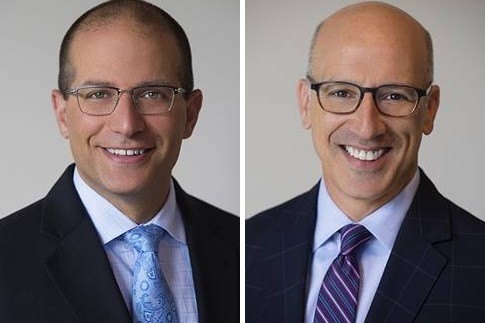
Editor's note: The following letter was submitted by Rabbi Michael Moskowitz and Rabbi Daniel Schwartz of Temple Shir Shalom in West Bloomfield. The views expressed are those of the authors.
Three years after the October 7 attacks on Israel, antisemitism in America has exploded. It has led many American Jews to feel a sense of insecurity in a country where our ancestors had thrived and felt safe. Until March, much of that insecurity stemmed from horrifically nasty and disturbing rhetoric, but only rare episodes of violence. And then Temple Israel, just down the road from us, was under attack.
A man drove a pickup truck into the synagogue, ignited fireworks and gas cans and opened fire on the security guards – security that has become a sad requirement for Jewish synagogues and institutions – in what the FBI would call a “Hezbollah-inspired act of terrorism.” We call it a very real reason to take antisemitism – including the hateful language that animates it – seriously.
As rabbis here in metro Detroit, we have witnessed a disturbing rise in antisemitism, including threats against Jewish institutions across the United States. In 2025, the Anti-Defamation League recorded 1,129 antisemitic incidents at Jewish institutions nationwide.
But it was the Temple Israel attack – just one, albeit big, act of antisemitism – coupled with the increasing apathy from both political parties about the concerns of American Jews, that have scarred our community and deepened our unease.
The attack also underscored how people increasingly see American Jews as legitimate targets for hate and violence because they view us as proxies for Israel – and therefore deserving of punishment.
What they don’t realize is that while the overwhelming majority of our community cares deeply about Israel, American Jews hold a range of views about Israel’s government and the choices it makes. Many of us favor a two-state solution and support Palestinian rights and dignity. Some don’t. What unites us is the conviction that Jewish statehood and self-governance in a Jewish and democratic Israel is nonnegotiable, and that no American of any ethnic or religious background should be made to answer for the decisions of any foreign government – let alone violently.
Antisemitism mutates and manifests differently in different times and ideological spaces, but more and more commonly, centuries-old anti-Jewish tropes are being normalized on both sides of the American political aisle. On the left, the word “Zionist” is being used as a slur or a pejorative, lazily using those who care about Israel as a stand-in boogeyman for the perceived flaws of American society, especially rising inequality and economic instability. On the right, conspiracy theories about “globalists,” Israel-supporters, and shadowy figures pulling the strings of elections, media, and immigration have become all the more common.
Candidates here in Michigan have also used words that hurt and alienate their Jewish constituents. Shortly after the Temple Israel attack, U.S. Senate candidate Abdul El-Sayed condemned it and expressed solidarity with our community. We appreciated that. But he also connected the violence to the attacker's reported loss of relatives in an Israeli airstrike, saying “hurt people hurt people.” Many in our community heard that as an explanation that seemed to excuse the attack. El-Sayed later acknowledged that his remarks were a mistake and apologized for the pain they caused. But he continued to suggest that such context was appropriate at another time, leaving our underlying concerns about his remarks unresolved.
He has also described Israel as “bloodthirsty” and “evil,” and spoken about pro-Israel political advocacy in terms of money and purchased influence. This imprecise rhetoric calls to mind old stereotypes about Jews and creates a permission structure for hate, which is why many of us find them troubling. We cannot judge a candidate’s heart, only the words they choose and how those words are heard.
In a letter this month to Michigan’s Jewish community, El-Sayed promised to stand against antisemitism and expressed a commitment to continued learning and dialogue. We welcome that commitment. Leaders of Nonnegotiable Michigan have asked for a shift in language and a sense of empathy and true solidarity with our community for over six weeks, but unfortunately have yet to receive any response.
Many in our community share Dr. El-Sayed’s views on health care, the economy and the protection of our democracy. That is precisely what makes this so painful. Jewish voters, like all Americans, want to weigh the full range of issues when we cast our ballots. We just don’t believe we should have to choose between our liberal convictions and our safety as Jews.
Every candidate, of every party, needs to remember that their words have consequences. Soundbites can spread like wildfire and can easily make an old stereotype sound acceptable. Leaders are free to take issue with the Israeli government’s policy choices – we do, often – but they must heed our community’s plea to avoid the kind of antisemitic rhetoric that has fueled the hatred and isolation of Jews for millennia.
All we are asking is for our political leaders to hear our concerns about language that we worry might spill into discrimination and violence against our community – the same way both we and they would for any other marginalized group.
We hope every candidate on the ballot this November, Democrat, Republican, or independent, can find their way toward allyship without alienation, so we can make sure what happened to Temple Israel doesn’t happen anywhere else. Get that right, and Jewish voters will be eager to stand with you. We want to support candidates who share our values. In 1790, George Washington wrote to the Jewish congregation in Newport, Rhode Island, that this nation would give “to bigotry no sanction, to persecution no assistance.” That promise is part of what our parents and grandparents believed in when they helped build their lives, their communities, and this country. Right now, too many of us feel that promise slipping away.
To help them understand how, we joined Nonnegotiable Michigan, a coalition of rabbis and Jewish leaders across the state asking candidates to commit to basic principles of Jewish safety, identity, statehood, political participation, and a desire for peace.
Our community spans the political spectrum, and we want to be able to support candidates up and down the ballot on the basis of policy alone. America is not living up to its ideals when any community is forced to question, as their singular issue, whether a candidate will keep them safe or contribute to their collective vulnerability. What we are asking is for every candidate, starting with those who seek to represent Michigan in the Senate, to listen to our concerns and affirm the basic human needs of our safety, our identity and community.
Rabbi Michael Moskowitz and Rabbi Daniel Schwartz are the rabbis of Temple Shir Shalom in West Bloomfield, Michigan.